Example 1: Hinge–Square Composite Loss
This notebook walks through the plqcom workflow for a custom classification loss: define a PLQ composite, decompose it to ReLU–ReHU form, broadcast per-sample affine maps, and solve with ReHLine (low-level API only).
Prototype loss on the margin \(z\):
[1]:
import numpy as np

z = np.linspace(-2, 2, 100)
L1 = np.maximum(1 - z, 0)
L2 = 0.5 * (1 - z) ** 2
[2]:
import matplotlib.pyplot as plt

plt.figure(figsize=(4, 3))
plt.plot(z, L1, marker='o', label='Hinge Loss')
plt.plot(z, L2, marker='s', label='Square Loss')
plt.plot(z, np.maximum(L1, L2), marker='^', label='PLQ Loss')
plt.legend()
plt.xlabel('z')
plt.ylabel('L(z)')
plt.title('Hinge Loss and Square Loss')
plt.show()

1. Data Generation
Synthetic binary classification data with \(n{=}1000\) samples and \(d{=}3\) features. The variable C = 0.5 is the ReHLine ERM weight (used in step 4).
[3]:
from plqcom import PLQLoss, plq_to_rehloss, affine_transformation
from rehline import ReHLine
from rehline._base import _relu, _rehu
Draw \(\mathbf{X}\in\mathbb{R}^{1000\times 3}\) and \(\mathbf{y}\in\{-1,+1\}^{1000}\).
[4]:
# Generate a random classification dataset
n, d, C = 1000, 3, 0.5
np.random.seed(1024)
X = np.random.randn(n, d)
beta = np.random.randn(d)
y = np.sign(X.dot(beta) + np.random.randn(n))
First 10 samples of the dataset
[5]:
X[:10], y[:10]
[5]:
(array([[ 2.12444863,  0.25264613,  1.45417876],
        [ 0.56923979,  0.45822365, -0.80933344],
        [ 0.86407349,  0.20170137, -1.87529904],
        [-0.56850693, -0.06510141,  0.80681666],
        [-0.5778176 ,  0.57306064, -0.33667496],
        [ 0.29700734, -0.37480416,  0.15510474],
        [ 0.70485719,  0.8452178 , -0.65818079],
        [ 0.56810558,  0.51538125, -0.61564998],
        [ 0.92611427, -1.28591285,  1.43014026],
        [-0.4254975 , -0.40257712,  0.60410409]]),
 array([ 1., -1., -1., -1., -1.,  1., -1., -1.,  1.,  1.]))
[6]:
X[:10].dot(beta)
[6]:
array([ 4.63095617, -1.53086335, -3.77183917,  1.49927261, -1.1677152 ,
        0.56448038, -1.12647624, -1.09186115,  3.93541798,  1.1463427 ])
2. Create and Decompose the PLQ Loss
Define the loss in max form (quad_coef only):
[7]:
plqloss_1 = PLQLoss(
    quad_coef={'a': np.array([0., 0., 0.5]), 'b': np.array([0., -1., -1.]), 'c': np.array([0., 1., 0.5])},
    form='max')
Equivalent PLQ form with explicit cutpoints:
[8]:
plqloss_2 = PLQLoss(
    quad_coef={'a': np.array([0.5, 0., 0.5]), 'b': np.array([-1., -1., -1.]), 'c': np.array([0.5, 1., 0.5])},
    cutpoints=np.array([-1., 1.]),
    form='plq')
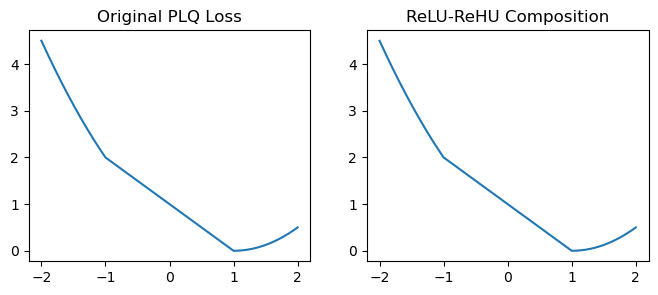
Decompose to ReLU–ReHU coefficients with plq_to_rehloss:
[9]:
rehloss_1 = plq_to_rehloss(plqloss_1)
rehloss_2 = plq_to_rehloss(plqloss_2)
[10]:
rehloss_1.relu_coef, rehloss_1.relu_intercept, rehloss_1.rehu_cut, rehloss_1.rehu_coef, rehloss_1.rehu_intercept
rehloss_2.relu_coef, rehloss_2.relu_intercept, rehloss_2.rehu_cut, rehloss_2.rehu_coef, rehloss_2.rehu_intercept
[10]:
(array([[-1.],
        [-1.]]),
 array([[ 1.],
        [-1.]]),
 array([[inf],
        [inf]]),
 array([[-1.],
        [ 1.]]),
 array([[-1.],
        [-1.]]))
[11]:
rehloss_1.rehu_coef == rehloss_2.rehu_coef
[11]:
array([[ True],
       [ True]])
[12]:
plt.figure(figsize=(8, 3))
plt.subplot(1, 2, 1)
Z = np.linspace(-2, 2, 1000)
L = plqloss_1(Z)
plt.plot(Z, L)
plt.title('Original PLQ Loss')

plt.subplot(1, 2, 2)
relu_coef, relu_intercept = rehloss_1.relu_coef, rehloss_1.relu_intercept
rehu_cut, rehu_coef, rehu_intercept = rehloss_1.rehu_cut, rehloss_1.rehu_coef, rehloss_1.rehu_intercept
Reh = np.sum(_rehu(rehu_coef * Z + rehu_intercept, rehu_cut), axis=0) + np.sum(_relu(relu_coef * Z + relu_intercept),
                                                                              axis=0)
plt.plot(Z, Reh)
plt.title('ReLU-ReHU Composition')
plt.show()
3. Broadcast to All Samples
For this classification problem,
So \(L_i(z_i)=\tfrac{1}{2}L(y_i z_i)\) with \(p_i=y_i\), \(q_i=0\). The factor \(\tfrac{1}{2}\) is already in the PLQ coefficients from step 2.
rehline :math:`geq` 0.1.0: use c=1 in affine_transformation below; set ERM strength only via ReHLine(C=C) in step 4. Do not pass c=C — that applies the penalty twice.
[13]:
# c=1: uniform weights; ERM strength is set by ReHLine(C=C) in step 4
rehloss = affine_transformation(rehloss_1, n=X.shape[0], c=1, p=y, q=0)
[14]:
print(rehloss.relu_coef, rehloss.relu_intercept, rehloss.rehu_cut, rehloss.rehu_coef, rehloss.rehu_intercept)
[[-0.5  0.5  0.5 ...  0.5  0.5 -0.5]
 [-0.5  0.5  0.5 ...  0.5  0.5 -0.5]] [[ 0.5  0.5  0.5 ...  0.5  0.5  0.5]
 [-0.5 -0.5 -0.5 ... -0.5 -0.5 -0.5]] [[inf inf inf ... inf inf inf]
 [inf inf inf ... inf inf inf]] [[-0.70710678  0.70710678  0.70710678 ...  0.70710678  0.70710678
  -0.70710678]
 [ 0.70710678 -0.70710678 -0.70710678 ... -0.70710678 -0.70710678
   0.70710678]] [[-0.70710678 -0.70710678 -0.70710678 ... -0.70710678 -0.70710678
  -0.70710678]
 [-0.70710678 -0.70710678 -0.70710678 ... -0.70710678 -0.70710678
  -0.70710678]]
4. Solve with ReHLine
Custom composite losses use the low-level API: pass decomposed _U, _V, _Tau, _S, _T and call fit(X).
[15]:
clf = ReHLine(C=C)
clf._U, clf._V, clf._Tau, clf._S, clf._T = rehloss.relu_coef, rehloss.relu_intercept, rehloss.rehu_cut, rehloss.rehu_coef, rehloss.rehu_intercept
clf.fit(X=X)
print('sol provided by rehline: %s' % clf.coef_)
print('decision_function: %s' % clf.decision_function([[.1, .2, .3]]))
print('precision: %s' % (np.sum(np.sign(X.dot(clf.coef_)) == y) / n))
sol provided by rehline: [ 0.20339926 -0.00843538  0.69527244]
decision_function: [0.22723458]
precision: 0.868